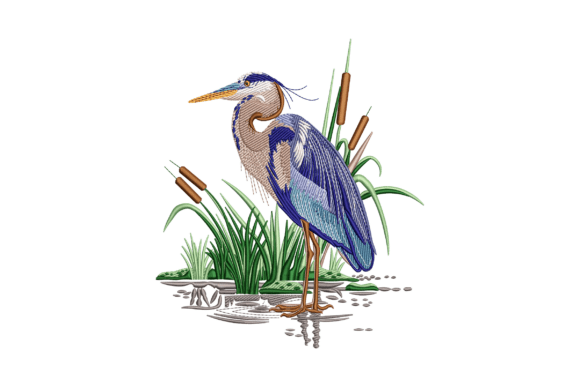
Blue Heron Embroidery Design Review
First Impression: Elegant, Calm, and Professionally Grounded
As an embroidery designer who’s developed hundreds of commercial designs for small businesses, my first read on Blue Heron is immediate: it reads as elegant—not fussy, not cartoonish, not overly stylized. The title alone evokes quiet confidence and natural sophistication. For a café named “Herons & Honey,” a florist with native plant branding, or a boutique that curates mindful handmade goods, Blue Heron doesn’t shout—it invites. It feels like a signature, not a sticker. That’s rare in the Birds category, where many machine embroidery designs default to bold outlines or exaggerated proportions. This one leans into subtlety and flow—ideal for brands building recognition through consistency, not clutter.
Real-World Business Use: Where Blue Heron Shines
Blue Heron performs exceptionally well across high-impact small business merch touchpoints:
- Embroidered patches: Its clean silhouette and balanced negative space hold up beautifully at 2"–3" sizes—perfect for sew-on or iron-on application on jackets, aprons, and tote bags.
- Staff uniforms and aprons: Positioned on the chest or sleeve, Blue Heron adds distinction without overwhelming function. It signals care and craftsmanship—especially important for bakeries, studios, and local service brands.
- Cap embroidery: When scaled thoughtfully (ideally 2.25" wide), it maintains legibility and grace on curved front panels—no distortion or stitch pile-up if digitized with smooth underlay and tapered satin edges.
- Tote bag design: As a centered chest logo or side accent, it elevates reusable merch from utilitarian to desirable—key for eco-conscious boutiques and farmers’ market vendors.
- Product packaging accents: Think stitched tags on handmade soap wraps, linen pouches, or ceramic labels—Blue Heron becomes part of the unboxing experience, reinforcing brand identity before the product is even opened.
- Etsy branding and craft business assets: Paired with neutral thread colors (navy, charcoal, oat, or ecru), it supports a cohesive printable mockup library and digital embroidery file suite—critical for scaling handmade product lines.
Where to Apply Caution—and Why
Even elegant designs need smart deployment. Here’s where Blue Heron requires thoughtful adaptation:
- Small patch sizes under 1.75": Fine details—like delicate leg taper or wing feather definition—may blur. Always test at intended size before bulk production.
- Cap fronts with heavy curvature: Digitizing must include strategic jump stitches and reduced density in tight curves to prevent puckering.
- Textured fabric (burlap, thick canvas, fleece): High stitch density can sink or distort. Pair with cutaway stabilizer and adjust top tension accordingly.
- Dark uniforms or black totes: Light thread colors (e.g., pale blue or silver) may lack contrast. Opt for navy, slate, or deep teal threads to preserve elegance while ensuring visibility.
- Frequent-wash items (aprons, work shirts): Confirm the embroidery file uses secure underlay and lock stitches—not just decorative fill. Durability starts in digitizing.
Brand Identity Impact: More Than Just a Bird
For small business owners, every embroidered detail contributes to perceived value. Blue Heron strengthens brand identity by projecting calm authority and intentional design—not randomness or clip-art energy. Customers subconsciously associate its graceful posture with trustworthiness; its nature-rooted aesthetic resonates with sustainability, localism, and authenticity. When used consistently across aprons, tote bags, and staff caps, it builds visual rhythm—making your brand instantly recognizable at markets, pop-ups, or neighborhood walks. Unlike generic floral or script logos, Blue Heron stands out in a crowded handmade product landscape while remaining versatile enough for seasonal reinterpretation (e.g., subtle thread color shifts for spring vs. autumn collections).
Practical Designer Notes Before You Stitch
Before committing Blue Heron to client work or inventory, run these checks:
- Test in black and white first: Eliminates color bias—reveals true balance, spacing, and edge clarity.
- Verify small-patch viability: Resize to 1.75" and inspect stitch paths in your embroidery software. Watch for tiny fills or overlapping satin columns.
- Review thread color contrast on actual fabric swatches—not just screen previews. Lighting changes everything.
- Inspect spacing between elements: Especially between legs, neck curve, and wing tip—tight gaps can vanish or cause nesting on low-stitch-count runs.
- Confirm hoop size compatibility: Does it fit standard 4x4 or require 5x7? Crucial for shops with limited hoop inventory.
- Test on real fabric + stabilizer combo: A perfect digital file fails without proper backing—especially on stretchy or napped materials.
- Create a physical mockup for client approval: Photos don’t capture texture, sheen, or drape. Let them feel the finished product.
- Compare beside existing design assets: Does Blue Heron harmonize with your current logo, typography, and palette—or does it compete?
- Confirm commercial licensing: Since this is a digital embroidery file intended for small business merch and branded patch use, ensure redistribution rights are included—especially for Etsy sellers reselling finished goods.
Final Thought: A Strategic Asset, Not Just a Design
Blue Heron isn’t just another bird-themed embroidery file. It’s a quiet amplifier—elevating aprons, anchoring tote bags, distinguishing staff, and adding tactile credibility to handmade product lines. For embroidery shops, apparel decorators, and creative small businesses, it bridges nature-inspired storytelling with professional polish. Used intentionally—with attention to fabric, scale, and context—it becomes part of your brand’s voice, not just its decoration. In a world saturated with fast, forgettable merch, Blue Heron offers something rarer: presence, poise, and purpose.