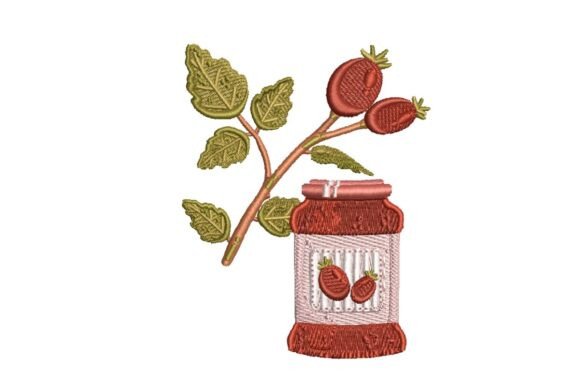
Hawthorn Jam Embroidery Design
First Impression: Rustic Charm with Kitchen Soul
As an embroidery designer who’s prepped over 200 craft fair booths, my gut reaction to Hawthorn Jam is immediate and warm: this is a rustic, gently elegant machine embroidery design—not too fussy, not too minimal. It leans into the quiet confidence of handmade food culture. The pairing of a jar, fresh berries, and botanical leaves signals authenticity, seasonality, and care—exactly what draws customers to small shop products at markets and on Etsy. It doesn’t shout; it invites. That subtlety is its strength—and its caution.
Where Hawthorn Jam Shines (and Where It Needs Support)
On a well-curated craft fair table, Hawthorn Jam performs best when placed where storytelling meets utility:
- Tote bag design: Centered on natural canvas or oat linen, it reads beautifully at 4–5 inches wide—large enough to be legible from three feet away, small enough to keep the bag’s shape clean. Avoid overcrowding with text or secondary motifs.
- Apron embroidery: Positioned just above the pocket (not centered on the chest), it adds personality without competing with function. Works especially well on denim or medium-weight cotton aprons—fabrics that hold stitch definition without stiffness.
- Tea towel embroidery: Here’s where Hawthorn Jam becomes a quiet hero. Stitched in muted berry tones (deep plum thread, sage green, cream) on unbleached flour-sack cotton, it feels like heirloom kitchen decor—not a logo, but a moment.
- Embroidered patch: At 2.5–3 inches, this design translates cleanly into a sew-on or iron-on patch. Ideal for bundling with mason jars, honey spoons, or as a “thank you” add-on for Etsy orders.
- Fabric pouch & pillow cover: On linen-blend pouches or textured oat-colored pillow covers, Hawthorn Jam reads as intentional, boutique-level detail—not filler. Its organic shape flows with relaxed fabric drape.
Real-World Production Notes Every Designer Should Check
This isn’t just about aesthetics—it’s about what ships on time, sells at full price, and earns repeat buyers. Before batch-producing Hawthorn Jam as a craft fair product or digital embroidery file, run these checks:
- Test on scrap fabric—especially your go-to tea towel or apron material. Does the jar lid read clearly? Do berry clusters stay distinct, or do they blur together?
- Check thread contrast on dark fabric. Light-thread versions may vanish on charcoal linen unless you use underlay or topping stabilizer.
- Review spacing between jar and leaves. Tight spacing risks skipped stitches on textured towels or curved cap surfaces—common pitfalls for commercial embroidery.
- Confirm hoop size compatibility. If the design pushes 5x7", verify it fits your most-used hoops—and your team’s workflow.
- Inspect stitch density. Berries and leaf veins can pack dense fill areas. Overly dense sections risk puckering on lightweight cotton or bleeding through thin fabric.
- Use the right stabilizer: Tear-away works for stable weaves; cut-away adds security for stretchy or loosely woven fabrics like some market bags.
- Create at least one real mockup—not just a printable mockup. See how light hits the threads in person. Does it photograph well under booth lighting? Does it feel premium as a finished product?
- Compare fabric colors side-by-side. A soft sage thread may disappear on olive linen but pop on oat. Don’t assume—swatch.
- Confirm commercial licensing before selling embroidered items. If Hawthorn Jam is a licensed digital embroidery file, ensure your use case (e.g., physical tote bags sold at craft fairs) falls within permitted terms.
Careful-Use Scenarios: When Hawthorn Jam Needs Extra Attention
Not every surface is equal—and Hawthorn Jam’s charm lives in its detail. Be mindful on:
- Textured towels: Heavy loops can swallow fine berry outlines. Opt for slightly larger scale or simplified fill if clarity suffers.
- Curved cap surfaces: The jar’s round base and narrow neck may distort unless digitized with cap-friendly underlay and reduced density near seams.
- Dense stitch areas: Berry clusters and leaf stems are lovely—but test stitch-out speed and thread breaks on high-volume runs.
- Small lettering: If the design includes “Hawthorn Jam” text (not stated in description, but common), confirm legibility below 0.25" height—many buyers glance, not read.
- Dark fabric + light thread: May require topping stabilizer or a second pass for coverage—add that step to your production timeline.
Why Hawthorn Jam Builds Booth Strength & Buyer Trust
In a sea of glitter, geometric prints, and trending fonts, Hawthorn Jam stands out by being human-scale. It doesn’t chase algorithmic virality—it speaks to people who bake, preserve, host Sunday brunch, or gift thoughtfully. That resonance shows up in real ways:
- Visual appeal: Soft botanicals + food motif = instant warmth. Customers pause longer, ask questions, and remember your booth.
- Customer attention: It’s distinctive without being loud—ideal for mature, discerning shoppers who value handmade quality over mass-produced novelty.
- Product value: Paired with natural fibers and thoughtful packaging, Hawthorn Jam elevates a $24 tea towel to a $36 gift-ready item.
- Brand consistency: Works seamlessly across categories—aprons, patches, pouches—creating a cohesive, ownable aesthetic for your small shop product line.
- Booth display strength: Group it with complementary items—wooden spoons, dried lavender bundles, ceramic jam jars—to tell a full sensory story.
- Buyer engagement: People love to share *why* they bought something. “I got this because I forage hawthorn every May”—that’s word-of-mouth gold for an Etsy seller or creative entrepreneur.
Final Thought: A Dessert-Themed Embroidery Design That Feels Like Home
Hawthorn Jam isn’t just another dessert-themed embroidery design—it’s a mood, a memory, and a market-ready asset. As a machine embroidery design, it balances delicacy with durability. As a craft fair product, it converts glances into conversations. As a handmade product, it carries intention in every stitch. Just remember: its quiet power only emerges when executed with care—right fabric, right stabilizer, right scale, right story. Test it. Touch it. Show it beside real mason jars and sunlit linen. Then watch it sell—not because it’s trendy, but because it feels true.