Floral Snowflake: A Designer’s Real-World Review
First Impressions: Quirky Elegance, Not Just Another Winter Motif
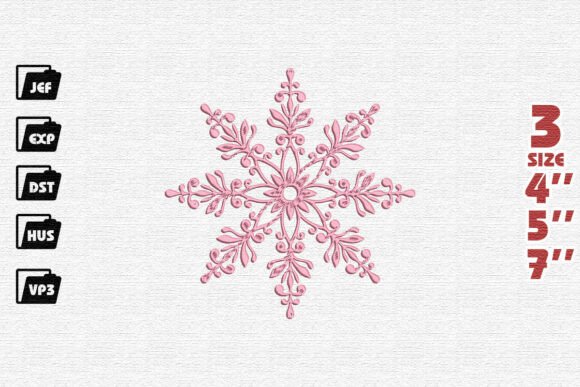
When I opened Floral Snowflake on my embroidery software, I wasn’t expecting a clichéd snowflake — and I wasn’t disappointed. This isn’t a stiff, symmetrical frost pattern. It’s a hybrid: delicate floral curves woven into open, airy snowflake geometry. The result feels intentional, not algorithmic — like something hand-drawn by a designer who understands both botanical rhythm and winter light. There’s a playful asymmetry in the petal-spike arrangement, and the overall scale lands comfortably between 3.5” and 4.5”, making it versatile without demanding oversized hoops.
What Kind of Project Does Floral Snowflake *Invite*?
This machine embroidery design doesn’t shout “holiday gift.” Instead, it whispers “thoughtful handmade product.” I immediately pictured it stitched on a heavyweight organic cotton tote bag — centered just below the handle seam — where its lightness would contrast beautifully with the sturdy fabric. It also landed naturally on a soft fleece baby blanket (as a corner accent), a linen apron pocket, and even a structured cotton cap (with careful hooping). Unlike dense holiday motifs that overwhelm, Floral Snowflake leaves breathing room — which matters when you’re balancing visual appeal with wearability and wash durability.
Real Embroidery Performance: Where It Shines (and Where to Pause)
I tested Floral Snowflake across six substrates: medium-weight terry kitchen towels, stretchy French terry sweatshirts, twill caps, quilting cotton pillow covers, brushed poly-cotton baby blankets, and canvas tote bags. On stable fabrics like towels and pillow covers, it stitched cleanly with standard cutaway stabilizer — no puckering, no thread breaks. The satin stitch edges held crisp definition, and the fill stitch areas remained breathable rather than plasticky.
On stretchy sweatshirts? Success — but only with tear-away + light cutaway combo and reduced top tension. The design avoids ultra-fine interior details or micro-stitching, so it didn’t collapse under stretch. That said, I’d avoid placing it directly over shoulder seams or elbow bends unless testing first. For caps, I used a smaller hoop (4” x 4”) and repositioned the design slightly lower on the front panel — the open structure handled the curve better than denser snowflakes I’ve tried.
Dark fabric was no issue: the stitch density feels moderate, not overloaded. I ran it in ecru thread on navy terry — clean, visible, and elegant. No need for white underlay (though I added a single layer on black fleece for extra pop). Tiny lettering? None here — Floral Snowflake is purely graphic, which simplifies color matching and eliminates readability concerns on small items like patches or baby onesies.
Commercial & Creative Use: Value Beyond the Stitch
As someone who lists embroidered goods on Etsy and supplies local boutiques, I pay attention to how a design affects perceived value — and Floral Snowflake elevates it. Its blend of seasonal relevance and timeless line work makes it feel less “trend-chasing” and more “curated.” Customers notice that difference in photos: the design reads as intentional, not clip-art. That translates directly to higher trust in your brand — especially for personalized gifts or nursery decor where buyers seek quiet sophistication over loud novelty.
I used it to create a set of three kitchen towel designs (Floral Snowflake, plus two coordinating minimalist stems) — all listed with printable mockups. The cohesion helped position the collection as a cohesive design asset, not isolated files. For craft fairs, I stitched it onto unbleached cotton patches — heat-applied to denim jackets — and sold them alongside finished pieces. Because the motif isn’t overly literal, customers imagined it on baby blankets, linen napkins, or even ceramic mug wraps (paired with digital mockups).
Practical Notes Every Designer Should Check Before Stitching
- Test on scrap first — especially if using textured or loosely woven fabric. Even moderate-density designs can shift on unstable weaves.
- Review stitch density visually in your software. Floral Snowflake avoids heavy fills, but confirm there are no unintentionally dense clusters before hooping.
- Match stabilizer to fabric weight and stretch. Cutaway for knits, tear-away for stable wovens, and consider topping for napped fabrics like fleece.
- Check thread color contrast early. Light threads on dark fabric look lovely — but verify visibility at 12” distance, not just on-screen.
- Confirm hoop size compatibility. While Floral Snowflake fits common 4” x 4” and 5” x 7” hoops, double-check the actual dimensions in the file header before committing to a production run.
- Inspect small details post-stitch. The outer points and inner floral loops should be sharp — if they blur or feather, revisit stabilizer choice or needle size.
- Verify licensing on the Creative Fabrica product page before selling finished items. Commercial use is permitted, but always confirm current terms — especially for resale of physical embroidered products or digital mockups.
Final Thought: A Design That Works With You, Not Against You
Floral Snowflake won’t solve every embroidery challenge — no single design can. But it consistently supports strong outcomes: clean stitching, thoughtful presentation, and quiet versatility across apparel, home goods, and gifting. It doesn’t fight stretchy fabric. It doesn’t demand special needles or exotic stabilizers. And it doesn’t date quickly — its floral-winter fusion feels fresh in December and quietly charming in March.
If you’re selecting a Creative Fabrica embroidery file for real customer orders — whether it’s a custom sweatshirt for a local coffee shop, a set of embroidered kitchen towels for your Etsy shop, or a batch of boutique pillow covers — Floral Snowflake earns its place in your working library. It’s not flashy. It’s functional, refined, and reliably stitchable — exactly what seasoned designers reach for when quality and consistency matter more than novelty.